Showing posts with label gas transit. Show all posts

Wednesday, May 27, 2020

After expiration of transit deal: Russian gas transit via Poland drys up

Reuters:

"Russian natural gas transit via the Yamal-Europe pipeline, which traverses Poland, has almost dried up, Interfax cited gas pipeline operators as saying on Monday, days after a gas transit deal between Moscow and Warsaw expired.

Russian gas giant Gazprom declined immediate comment.

The gas transit deal between Russia and Poland, dating back to the 1990s, expired on May 17 as Warsaw aligns its energy regulations with European Union rules and curbs its decades-old dependence on Russian fuel."


You can read the rest of the piece via the below link:

Wednesday, October 16, 2019

The disastrous consequences of Nord Stream 2 on Central European countries

Mikhail Korchemkin of EEGA (East European Gas Analysis) summarizes the the outlook of domestic gas production and gas demand in Europe and the impact Nord Stream 2 will have especiall on CSEE countries if pipelines through Ukraine are decommissioned:


"And Putin himself may be a bigger danger.

The history of Nord Stream 1, which terminates in Germany just as the Nord Stream 2 pipeline is planned to do, demonstrates that he’s more than willing to use pipelines for political leverage. After the commissioning of Nord Stream 1, he wanted to keep a tight grip on gas supplies to Ukraine, reducing them when the country angered him—either by cutting off some lines or hiking prices. But when Europe announced that it would resell Russian gas back to Ukraine at a lower price than Russia had offered, Putin got angry and in June 2014 threatened to punish the involved parties—Austrian, German, and Slovakian firms—by reducing the supply of Russian gas to their home countries.

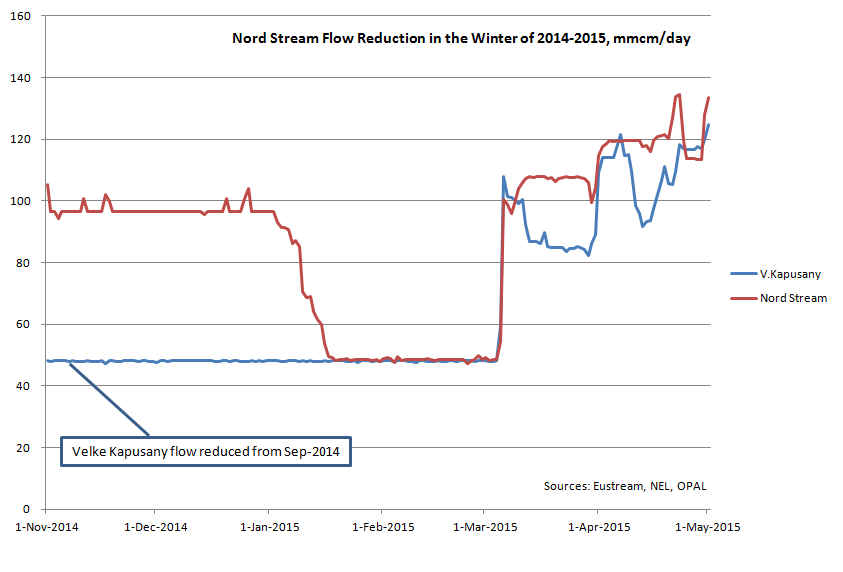
Despite Putin’s threat, the reverse gas sales went on. Believing that European consumers would be unlikely to notice any change of gas supply in the summer, Putin waited until the fall and ordered Gazprom to cut daily flows of Russian gas to Europe via Ukraine by 50 percent. In January 2015, the same reduction was applied its exports to Germany via the new and reliable Nord Stream 1. The case was never taken to arbitration court, and Putin acted as the judge and executioner.

As reported by Russia’s state news agency Interfax, that gambit resulted in a loss of $5.5 billion in revenue for Gazprom and fines of $400 million. Unfortunately for the Kremlin, the winter was warm, and the deficit in Europe was compensated by increased supplies from Norway. But for Putin, this matter was much more important than $6 billion and the reputation of Nord Stream. For him, being able to demonstrate that he could cut off supply to Europe on a whim was key. And now, with his pipeline plans fulfilled, he would be able to quickly cut off over 80 percent of the supply of Russian gas to the European Union on short notice."


You can read the rest of the piece in Foreign Policy via the below link:

https://foreignpolicy.com/2019/10/07/gazproms-nord-stream-2-will-help-putin-cut-off-natural-gas-supplies-to-europe/ 

Tuesday, September 10, 2019

Nord Stream 2: US congress hits pipe-laying companies

Foreign Policy describes the balancing act of US administration to impede russian dominated Nord Stream 2 pipeline and preserve a productive relationship with german and other european governments:

"The threat of sanctions is now more pronounced. Two bills in the House and the Senate, instead of penalizing the major gas companies involved, would target a perceived weak link: the specialized pipe-laying companies working on Nord Stream 2 (and on the Russian state-controlled gas company Gazprom’s TurkStream project, which will bring Russian gas across the Black Sea to Turkey and eventually to Europe). The bills would sanction pipe-laying companies involved in the project, freezing their U.S. assets and prohibiting them from doing U.S. business.  Only a handful of companies possess the pipe-laying technology Nord Stream 2 needs, and they are in high demand worldwide. One of them, the Swiss-based contractor Allseas—which is heavily exposed to the U.S. dollar and U.S. business—is essential to completing the pipeline, and the proposed sanctions could cause the company to withdraw. The bills have bipartisan support: The Senate Foreign Relations Committee passed the bill by a vote of 20 to two at the end of July, after the House version passed the House Foreign Affairs Committee with similar bipartisan approval. The bills’ widespread support across parties and chambers increases their likelihood of passing with a veto-proof majority, which could kill the pipeline or delay its completion by years."
(...)
"Since 2014, Germany has been the linchpin for sustaining EU sanctions against Russia for its aggression in Ukraine. Increasingly, countries such as Italy, Greece, and Hungary express a desire to end the sanctions, but Berlin has held the EU together. It is risky for the United States to subject Germany to increased political pressure on Nord Stream 2 at a time when solidarity on the more comprehensive sanctions effort is eroding. It would add to a growing list of U.S.-German tensions, including  U.S. tariffs on European aluminum and steel, U.S. demands that Germany increase its defense spending, the consequences of U.S. withdrawal over the Iran nuclear deal, and the question of how best to respond to China’s growing international economic role and the influence of its technology companies worldwide. It is hard to imagine a German government going out on a limb on other U.S. requests—whether for German participation in a maritime escort mission in the Persian Gulf or for German ground troop commitments in Syria—while Washington is sanctioning German companies over Nord Stream 2."

You can read the rest of the piece via the below link:
https://foreignpolicy.com/2019/09/02/maximum-pressure-on-germany-is-a-big-mistake/ 

Monday, September 9, 2019

New conflict over gas transit between Russia and Ukraine ahead

Interesting article by Steven Pifer for Brookings:

"Twice in the past 14 years, a dispute between Ukraine and Russia has led Russia to cut off natural gas flows to Ukraine and Europe. The stage is being set for another cut-off in January. The European Union wants to ensure that gas continues to flow, so EU officials will attempt at a mid-September meeting to broker an agreement. But they face a difficult slog.

Gazprom, a large Russian parastatal, now transits a significant amount of gas to European destinations via Ukrainian pipelines. The volume totaled 87 billion cubic meters (bcm) in 2018, one-third of Russian gas exports to Europe.

However, the contract that governs this gas transit expires at the end of 2019. Kyiv wants to replace the current agreement with another long-term contract, preferably for 10 years. Moscow, on the other hand, wants just one year.

Russia hopes to bring Nord Stream 2—which runs from Russia to Germany under the Baltic Sea—online in 2020. (The U.S. government has raised the possibility of sanctions against companies involved with Nord Stream 2, but the pipeline is already 75% complete.) Moscow also hopes that Turk Stream—two pipelines running under the Black Sea from Russia to Turkey—will reach full capacity next year. Nord Stream 2 will have a capacity of 55 bcm of gas per year. Turk Stream consists of two pipelines, each with an annual capacity of 15.75 bcm. The Turks plan to use half of the gas domestically and export the rest to southeastern Europe. If Gazprom can move an additional 70.75 BCM of gas to Europe via Nord Stream 2 and the Turk Stream pipelines after 2020, its need for the Ukrainian pipelines will drastically decline."


You can read the rest of the piece via the below link:
https://www.brookings.edu/blog/order-from-chaos/2019/08/30/heading-for-another-ukraine-russia-gas-fight/