Showing posts with label Versorgungssicherheit. Show all posts

Wednesday, October 16, 2019

The disastrous consequences of Nord Stream 2 on Central European countries

Mikhail Korchemkin of EEGA (East European Gas Analysis) summarizes the the outlook of domestic gas production and gas demand in Europe and the impact Nord Stream 2 will have especiall on CSEE countries if pipelines through Ukraine are decommissioned:


"And Putin himself may be a bigger danger.

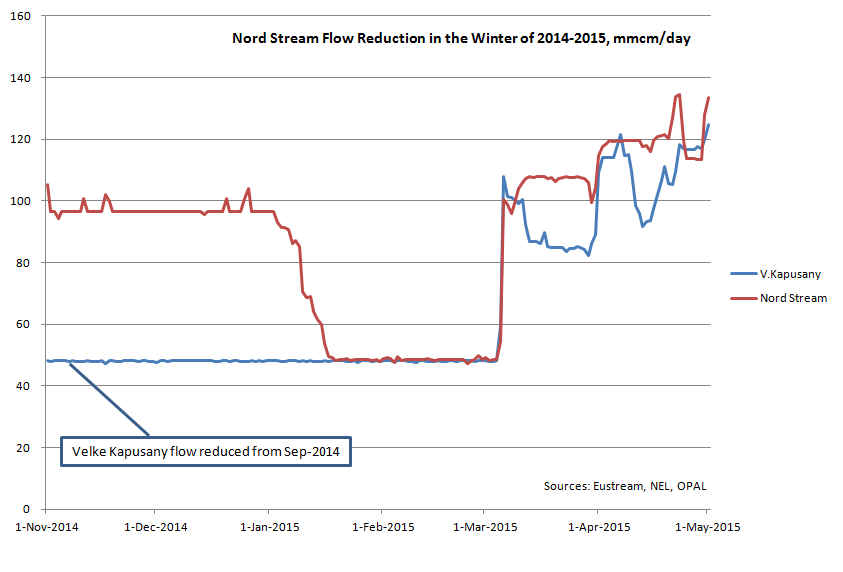
The history of Nord Stream 1, which terminates in Germany just as the Nord Stream 2 pipeline is planned to do, demonstrates that he’s more than willing to use pipelines for political leverage. After the commissioning of Nord Stream 1, he wanted to keep a tight grip on gas supplies to Ukraine, reducing them when the country angered him—either by cutting off some lines or hiking prices. But when Europe announced that it would resell Russian gas back to Ukraine at a lower price than Russia had offered, Putin got angry and in June 2014 threatened to punish the involved parties—Austrian, German, and Slovakian firms—by reducing the supply of Russian gas to their home countries.

Despite Putin’s threat, the reverse gas sales went on. Believing that European consumers would be unlikely to notice any change of gas supply in the summer, Putin waited until the fall and ordered Gazprom to cut daily flows of Russian gas to Europe via Ukraine by 50 percent. In January 2015, the same reduction was applied its exports to Germany via the new and reliable Nord Stream 1. The case was never taken to arbitration court, and Putin acted as the judge and executioner.

As reported by Russia’s state news agency Interfax, that gambit resulted in a loss of $5.5 billion in revenue for Gazprom and fines of $400 million. Unfortunately for the Kremlin, the winter was warm, and the deficit in Europe was compensated by increased supplies from Norway. But for Putin, this matter was much more important than $6 billion and the reputation of Nord Stream. For him, being able to demonstrate that he could cut off supply to Europe on a whim was key. And now, with his pipeline plans fulfilled, he would be able to quickly cut off over 80 percent of the supply of Russian gas to the European Union on short notice."


You can read the rest of the piece in Foreign Policy via the below link:

https://foreignpolicy.com/2019/10/07/gazproms-nord-stream-2-will-help-putin-cut-off-natural-gas-supplies-to-europe/ 

Friday, October 11, 2019

A plea for nuclear in Germany

German computer scientist and physicist Rainer Klute makes a case for the comeback of nuclear in an op-ed piece in german weekly paper "Die Zeit". He emphasises the use of nuclear waste for the operation of fast reactors.

"Deutschland braucht neue Atomkraftwerke.

Atomkraft? In Deutschland? Ist dieses Thema nicht spätestens mit dem Ausstiegsbeschluss von 2011 endgültig erledigt? Warum sollte sich das Land wieder Diskussionen über Kernenergie antun? Ganz einfach: Weil wir mit der CO₂-Bepreisung allein das Klima nicht retten werden. Und: Weil Physiker und Ingenieure in den vergangenen Jahren, unbemerkt von einer atomhysterischen Öffentlichkeit, gewaltige Fortschritte gemacht haben.

Inzwischen gibt es moderne Reaktoren, die Energie aus bereits angefallenem "Atommüll" gewinnen können. Allein aus den gebrauchten Brennelementen in den verschiedenen Zwischenlagern könnte Deutschland 250 Jahre lang komplett mit Strom versorgt werden. Die Reaktoren der sogenannten Generation IV würden damit nicht nur die Endlagerfrage lösen, sie würden auch die Menge des nutzbaren Urans um das 50- bis 80-Fache strecken, sodass es für Zehntausende Jahre Stromerzeugung reichen würde – und das alles klimafreundlich und emissionsfrei."


You can read the rest of the piece via the below link:

https://www.zeit.de/2019/41/kernkraftwerke-atomkraft-energiewende-atommuell/komplettansicht 

Friday, September 27, 2019

Experts: wind energy in Germany useless and expensive

Three physics professors of the university of Heidelberg have calculated that the share of wind (combined with solar) represents only 3,1% of the energy supply in Germany.
However from Januar to March 2019 deficiency compensation of 364 Million Euro had to be paid to operators of wind power stations for energy that couldn't be fed into the grid due to saturation.
The german EEG reallocation charge appears more and more like a wrong track for consumers who have to carry this burden.

https://www.physi.uni-heidelberg.de/~dubbers/energiewende/text.pdf 

Tuesday, August 27, 2019

Shellenberger: nuclear is safest energy power

Another interesting article, however here and there a bit polemical, about the safety of nuclear power:

"What about Three Mile Island? After the accident in 1979, Time Magazine ran a cover story that superimposed a glowing headline, “Nuclear Nightmare,” over an image of the plant. Nightmare? More like a dream. What other major industrial technology can suffer a catastrophic failure and not kill anyone?

Remember when the Deepwater Horizon oil drilling rig caught on fire and killed 11 people? Four months later, a Pacific Gas & Electric natural gas pipeline exploded just south of San Francisco and killed eight people sleeping in their beds. And that was just one year, 2010.

The worst energy accident of all time was the 1975 collapse of the Banqiao hydroelectric dam in China. It collapsed and killed between 170,000 and 230,000 people.

Nuclear’s worst accidents show that the technology has always been safe for the same, inherent reason that it has always had such a small environmental impact: the high energy density of its fuel."


You can read the rest of the piece via the below link:

https://www.forbes.com/sites/michaelshellenberger/2019/03/11/it-sounds-crazy-but-fukushima-chernobyl-and-three-mile-island-show-why-nuclear-is-inherently-safe/#4580f4781688 

The "non-problem" of nuclear waste

A quite interesting take by Michael Shellenberger on "irrational fears" concerning nuclear waste and nuclear plants as the "backbone to our future clean energy system".

"Nuclear waste has never been a real problem. In fact, it’s the best solution to the environmental impacts from energy production.
Consider:


  • No way of making electricity other than nuclear power safely manages and pays for any its waste.

In other words, nuclear power’s waste by-products aren‘t a mark against the technology, they are its key selling point."

You can read the rest of the piece via the below link:

https://www.forbes.com/sites/michaelshellenberger/2018/06/19/stop-letting-your-ridiculous-fears-of-nuclear-waste-kill-the-planet/#3c20dace562e 

Sunday, August 25, 2019

Expert: energy transition to renewables in Germany unrealistic

For Robert Schlögl, director of Fritz-Haber-Institut and Max-Planck-Institut for energy conversion, the shut down of conventional power plants and replacement by wind and solar won't work as renewable energies are subject to fluctuations. Also battery technology for storage has physical limits.

You can read the interesting interview via the below link:

https://www.welt.de/wissenschaft/plus199039073/Klimaneutralitaet-Grundidee-der-Energiewende-absolut-unsinnig.html 

Thursday, August 22, 2019

Nord Stream 2 pipeline project under pressure from different actors

The controversial Gazprom-dominated pipeline project Nord Stream 2 faces hardship on the final sprint before completion.

Denmark has denied the route through its territorial waters and also rejects a permission of an alternative route through the exclusive economic zone.

The swiss subsidiary of  Nord Stream 2 has also filed a lawsuit against provisions of EU directive 2009/73/EC concerning common rules for the internal market in natural gas because it regards some previsions as discriminatory, for instance the incompatibility of the status of pipeline-operator and gas supplier.
 The outcome of the lawsuit is yet to be known.

Lastly the US Senate committee on foreign relations has drafted a bill, the Protect European Energy Security Act, that would allow sanctions  against swiss and italian companies providing ships for the underwater construction works of the pipeline.

Those developments make the completion of the Nord Stream 2 pipeline questionable. 

https://www.bild.de/bild-plus/politik/ausland/politik-ausland/nord-stream-2-warum-es-fuer-putins-neue-ostsee-pipeline-noch-richtig-eng-wird-63692948,view=conversionToLogin.bild.html 


Wednesday, August 21, 2019

US-Sanktionen gegen Nord Stream 2 unterstützende Unternehmen

Während das Pipelineprojekt Nord Stream 2 derzeit aufgrund der Weigerung Dänemarks der Streckenführung der Pipeline durch dänisches Hoheitsgebiet zuzustimmen stillsteht, arbeitet der US-Senat ein Gesetzesvorhaben aus, das Sanktionen gegen Unternehmen vorsieht, die am Bau der Pipeline beteiligt sind.

Es handelt sich dabei insbesondere um Schiffe zur Pipelineverlegung auf See, eine technische Leistung, die der Hauptaktionär an der Betreibergesellschaft Nord Stream AG, der russische Gaskonzern und Exporteur Gazprom nicht selbständig erbringen kann.

Konkret benannt wurden das eidgenössische Unternehmen Allseas und das italienische Unternehmen Saipem. Die Sanktionen könnten sich auch auf Finanzierer, Versicherer und technische Dienstleister dieser Unternehmen erstrecken.

Auf diese Weise versuchen die Vereinigen Staaten, das umstrittene Pipelineprojekt, welches die durch die Ukraine geführten Pipelines ersetzen soll, doch noch zu Fall zu bringen.

Mehr in diesem Artikel von Forein Policy:

https://foreignpolicy.com/2019/05/13/us-senate-threatens-sanctions-over-russian-pipeline-nord-stream-two-geopolitics-energy-germany-europe-gazprom/

Energieanalysten ziehen außerdem die Angaben der Betreibergesellschaft und von Gazprom in Zweifel, wonach die Gaspreise für europäische Verbraucher durch die Nord Stream 2 Pipeline fallen würden.

Marktrealitäten und die vor allem Erfahrungen aus der Vergangenheit mit Gazprom zeigen, dass Gaspreise im Fall eines Imports von Pipelinegas nicht fallen.

Die Energieexperten Anders Åslund und Agnia Grigas beim Atlantic Council kommentieren diese Behauptungen wie folgt:

„Commenting on the putative 8 billion euro potential savings for European gas consumers if Nord Stream 2 is built, Anders Åslund, a Senior Fellow at the Atlantic Council, told Polygraph.info that the Russians are constantly coming up with bizarre numbers to protect and expand their gas market share. “The cost of Russian natural gas is indeed lower than LNG, but who benefits from it? Only the producers, not the consumers,” Åslund said. “Gazprom can be more flexible with the sale prices, but it is not.”

“Gazprom is not building its project in order to save European consumers money; in fact, it is building it to maintain and entrench its positions on the European markets right at the time when Europe is seeing more options and more liquidity,” Agnia Grigas, a nonresident senior fellow with the Atlantic Council's Eurasia Center, told Polygraph.info. She added that the Nord Stream 2 project is Gazprom’s way of fighting against the competition, an attempt to lock the European market by tying it to Russian pipelines in order to preempt alternative gas supplies.

“I certainly don’t expect gas prices to drop; on the contrary, in countries where Gazprom has established positions, gas prices tend to rise,” said Grigas.

Lithuania’s experience demonstrates this: as soon as Vilnius started planning to build an LNG regasification terminal at Klaipeda, Gazprom had to decrease its prices in Lithuania."

Weitere Details in diesem Artikel:

https://www.polygraph.info/a/nords-stream-2-will-not-reduce-natural-gas-prices-in-europe-fact-check/29933914.html

Deutsch-französische Misshelligkeiten um Nord Stream 2

Während die Fertigstellung der umstrittenen Unterwasserpipeline "Nordstream 2" nunmehr Kurs auf die Zielgerade nimmt, werden von Deutschlands europäischen Nachbarn Einwände angemeldet.

Die baltischen Staaten, aber auch Polen und vor allem die Ukraine haben das Projekt, mit dem Deutschland jährlich 55 Milliarden Kubikmeter Gas – zusätzlich zu den bisher 51 Milliarden Kubikmetern, die durch "Nordstream 1" fließen – direkt aus Russland importieren will, mit großer Skepsis betrachtet, da es ihre Energie- und Sicherheitsinteressen beeinträchtigt.

Der Energieexperte Wojciech Jakóbik skizzierte gegenüber dem Verfasser die lagerübergreifend vorherrschende Position in Polen, indem er "Nordstream 2" als politische und ökonomische Bedrohung. In politischer Hinsicht führt sie zur Spaltung Europas und könnte zudem ein Erpressungspotential gegenüber der Ukraine bedeuten. Ökonomisch führt die Pipeline dazu, dass die Nachfrage aus einer dominierenden Quelle befriedigt wird, was den Markt verzerrt und ihm schadet.